ko-mono-20
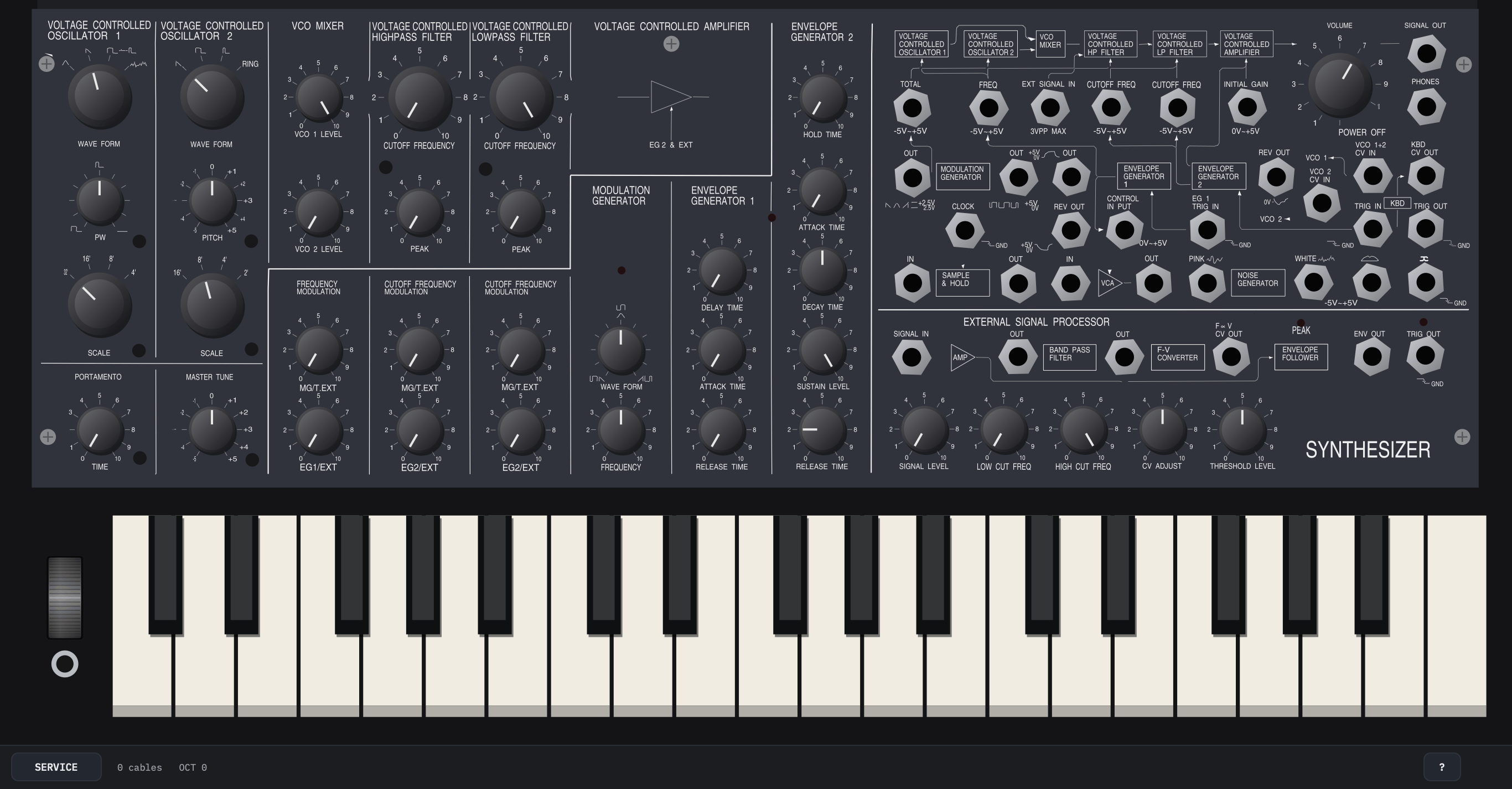
Korg MS-20 emulation
Expect bugs, and changes before 1.0. The installers aren't signed yet, so macOS and Windows warn before opening them. How to open them
- Emulates
- Korg MS-20
- Year
- 1978
- Type
- mono synth
- Status
- working
- Without ROM
- [✓] no ROM needed
- Filter boards
- Rev 1 (KORG35) and Rev 2 (KLM-307), in SERVICE
- Patch panel
- 35 jacks, with your DAW's audio into ESP or EXT SIGNAL IN
- macOS 11+
- Universal: AU, VST3, standalone
- Windows 10+
- VST3, standalone
Release announcements by email
Nothing else is sent. Mailing list
In numbers
There's no MS-20 here, so we checked ours against the service manual's own adjustment procedure and against free recordings of about 20 real units. Method: How it was made.
The clips at the top are ko-mono-20 alone, with no effects, playing lines we wrote. The two screams are the same patch on each filter board.
What is still different
- Self-oscillation over the VCOs
- With PEAK up and a VCO playing, our LPF's whistle locks onto a harmonic and wobbles with vibrato, where one real unit's runs free between the harmonics. Another unit locks on as ours does, though, so it may just be that one.
- A cleaner whistle
- A real self-oscillating filter has a skirt of noise around its tone. Ours comes out cleaner, because we don't model the parts' own noise in the filters.
- The start of a scream
- While CUTOFF is low, a screaming LPF sweep starts 2-4 dB brighter than a real one above 2 kHz. Ours also needs PEAK 9.9 to match one unit at 9.5.
- Values against the drawings
- We use 33k for R161 where the drawing prints 1K, because one unit's envelope sweeps all want that, and 4.3k for R169 where the printed 43K would cap SUSTAIN at 13 %. Real boards have an R62 100K that the diagrams leave out, so ours has it too. On the Rev 2, R38 is 4.7k (printed 3.3K) and the VCA runs on about a fifth of the drawn current, so it comes out as loud as the Rev 1.
- Ranges and levels
- CUTOFF covers about 11.5 octaves as the drawing has it, where the specification says 50 Hz to 5 or 15 kHz, and the knob readings in recordings agree with the drawing. SIGNAL OUT reaches 0.95 Vpp where the block diagram says 2, and EG 1 rests at -7.5 V where the specification says -5.
- Noise
- The noise jacks give 2.1 Vpp against the specification's 5, and there's no 1/f or burst noise.
Not emulated
We don't model the power supply's ripple, the unit warming up or part tolerances, so every ko-mono-20 is the same unit (each one drifts and hisses on its own, though). PHONES isn't a plugin output, so you hear SIGNAL OUT.
Own an MS-20?
A clean recording of the LPF self-oscillating up the keyboard, with both VCOs turned down, would settle the whistle. Dry recordings of a Rev 2 with its settings written down would check what we fitted to one recording, and a photo of the main board where R161 and R169 can be read would settle two values we had to guess.
How it was made
- 01
The circuit
We transcribed every block from the service manual's circuit diagrams, part by part, and checked each netlist against ngspice running the same circuit. The VCOs, the filters and the VCA run as circuits at four times your DAW's rate, and the envelopes, the MG and the rest of the control side run on a second thread.
- 02
The service manual
Then we trimmed it with the manual's own adjustment procedure, the way a technician would, and all 46 of its checks pass.
- 03
Real units
We compared ours with free recordings of about 20 real MS-20s, event by event: the oscillators' waveforms and levels, the filters' sweeps and resonance, the FM depth, the MG's rates, the noise and the envelopes. Where the drawings leave a value out or get it wrong, we fitted it to those recordings (see Differences).
- 04
The Rev 2
We modelled the later KLM-307 filter board from its own drawing. Its limiter diodes, two resonance trims and VCA drive aren't printed or have no procedure, so we fitted them to the one recording we have of a Rev 2 played next to a Rev 1.
Panel artwork
KORG's logo is a trademark, so its place on the panel, bottom right, is blank. It takes an SVG or PNG file of your own, named ko-mono-20-maker, in the ROM folder. Draw it yourself or generate it with an AI tool such as Claude or ChatGPT. Panel artwork
ko-mono-20 is a circuit with no firmware, so it needs no ROM.