ro-mono-101

Roland SH-101 emulation

betaVersion 0.1.1 is a beta

Expect bugs, and changes before 1.0. The installers aren't signed yet, so macOS and Windows warn before opening them. How to open them

At real units' settings
Dataro-mono-101 0.1.1
Emulates
Roland SH-101
Year
1982
Type
mono synth
Status
working
Without ROM
[~] voice mode
ROM image
tmp80c49p-6-7301.ic6, not included
macOS 11+
Universal: AU, VST3, standalone
Windows 10+
VST3, standalone

Release announcements by email

Nothing else is sent. Mailing list

ro-mono-101 in voice mode: the SH-101 panel with its sliders, switches, buttons, bender and 32 keys, its brand marks' places left blank, and the plugin bar with SYNC and ?
A1Sequencer and arpeggio. The CPU, IC6, runs its original program from tmp80c49p-6-7301.ic6.
A2Synth board. Modelled part by part from the service notes.
FIG. 1Voice mode: the panel with its brand marks' places left blank, and the plugin bar with SYNC and ?.

In numbers

Checked against recordings of nine real SH-101s, an ngspice simulation of the transcribed schematic and the service notes' own checks. Method: How it was made.

The clips at the top: ro-mono-101 alone, with no effects, at the settings read off videos of three real units: Friendly Noise's for the ENV sweeps (the unit ro-mono-101 is calibrated to), Failed Muso's for the ping, the filter alone with the sources off, and Once Upon a Synth's for the portamento. The ping's video gives FREQ, RES and ENV; DECAY and SUSTAIN are inferred from the recording. For the portamento, FREQ is 3.8 where the video reads 2.6: that unit is about 1.2 octaves brighter than ro-mono-101 at the same settings.

7.28
octaves swept by ENV 10; the real unit's, 7.27
Friendly Noise's unit, which ro-mono-101 is calibrated to. Against a second unit, in two takes: each within 0.11 octave. Roland's SH-101 software sweeps 7.65; the schematic as transcribed, 7.7 or more (Differences).
0.11 dB
the whole voice's level against ngspice, filter open
Every block of the transcribed schematic joined into one circuit, from the VCO to the OUTPUT jack, 43 cases: harmonics within 0.33 dB, the filter's cutoff within 4 cents and its self-oscillation within 9 cents, the ENV to the VCA within 0.05 dB. Each block alone: 28 of 28 checks within their limits.
34 / 34
service-note checks passed
Every adjustment and specification in the service notes: the D/A in test mode, through the firmware; VCO TUNE, WIDTH and RANGE WIDTH, through the whole machine; VCF WIDTH; the cutoff, ENV, LFO, portamento, PWM, TUNE and output ranges; the sub-oscillator's waveforms.

What is still different

The ENV's depth
As transcribed, the schematic can't sweep less than 7.7 octaves at ENV 10 while KYBD tracks. Two real units sweep about 7.2, Roland's software 7.65. ro-mono-101 scales the ENV's weight at the cutoff to 0.82 of the schematic's to match. The measurement, the tracking, the chip's law, the parts on that path and the VCA switch are ruled out; the cause isn't known.
Units differ
In FREQ and RES. The service notes trim the filter's keyboard tracking, not where its cutoff sits. Once Upon a Synth's unit is about 1.2 octaves brighter than ro-mono-101 at the same settings, loopop's lower and more resonant. AutomaticGainsay's FREQ reads 5–8 % steeper per division, and its top RES reading sits 0.4 division past ours.
The filter chip
The IR3109 has no maker's data. It is modelled from Open Music Labs' decode and the AS3109 data sheet, with its law end to end from one Juno-106 voice. Its expo current is fitted to a real unit, at 1.7 times the decode's; its buffers' gain, 0.89–0.96, is uncertain by a few percent.
Noise
The schematic gives neither its level nor its colour. Both are set from real units, whose levels spread 2.7 dB.
Switching off and on
At POWER off, +9 V is taken to fall with a 12 ms time constant, an estimate. The thump follows it: −41 dBFS, −30 for a 5 ms fall, under −45 for 25 ms. The mute at POWER on is the circuit's. Neither has been compared with a recording.

Not emulated

CV/GATE in and out; the EXT CLK jack (SYNC stands in); the HOLD jack (CC 64 stands in); PHONES; the battery (the memory always keeps the sequence); the MGS-1 grip's own controls, beyond the lever's push.

Own an SH-101?

Recordings or measurements of a real unit at known settings settle these: the cutoff at several FREQ positions, a RES series, where self-oscillation starts, the voltages at IC18b's inputs at ENV 10.

The forum

How it was made

  1. 01

    Schematic and SPICE

    The synth board was transcribed from the service notes' schematic and modelled part by part: portamento, the pitch summer and the bender board, the CEM3340 VCO and the 4013 sub-oscillator, the noise source and the mixer, the MODULATOR, the IR3109 VCF with its resonance loop, the discrete ENV generator, the BA662A VCA, the output stage and jack board A's mute. Each block was compared with an ngspice simulation of the same transcription in 28 checks: against the VCF with the IR3109 at transistor level, the model is within 0.09 dB small-signal and self-oscillates within 6 cents up to 1 kHz. Then every block was joined into one circuit (In numbers). All 34 of the service notes' adjustments and specifications pass.

  2. 02

    Real boards

    Part values were read from the parts list of a dismantled unit (Din Sync), photos of six other units' boards and the service notes' own board diagram. They corrected four of the modulator's resistors to 100k (R169, R188, R31 and R35), and put R196 on S6's side of R197, which is why a real unit's VCA fades with the ENV to the end. A real unit's square LFO swings 0.74 of its triangle, as R31 at 100k gives.

  3. 03

    Calibration to real units

    The service notes trim the unit but leave values open: the IR3109 has no data sheet of its own, the ENV pots are ±20 %, and the schematic's ENV sweeps too far (Differences). The Real unit calibration, the one ro-mono-101 plays, takes them from recordings: Friendly Noise's unit, its sliders read off 1080p video, for where FREQ 0 sits and the ENV's sweep and times; another unit for the portamento. The first column is the unit as the service notes trim it, with nominal parts and the data sheets' values.

    PartService notesReal unit
    VCO tuning, A4442 Hz440 Hz
    IR3109 expo slope19.0 mV/oct20.8 mV/oct, measured on an original chip
    IR3109 expo current2.4 µA5.0 µA
    ENV's weight at the cutoff1.00.82
    ENV potsnominal0.9 × nominal
    Portamento τ at 100.66 s0.78 s, another unit's
    ENV 10's sweep7.7 octaves or more7.28 octaves; the unit's 7.27

    Then nine real units, per unit and per event, in 105 measurements: 60 within their limits, 4 known gaps (Differences), 41 for information. A second unit needs the same ENV weight; the portamento's top matches another within 0.01 s; the square and subs against the saw are within 1 dB on every note of three units; the noise's colour fits three. Twelve of the recordings, A/B against ro-mono-101 at the same settings, changed nothing: every difference heard was a setting or timing misread, the recording, or unit spread.

  4. 04

    The firmware

    The TMP80C49P-6-7301's program runs from reset on an emulated MCS-48 (ported from MAME's core) with the SH-101's key matrix, switch columns, 6-bit DAC and sample-and-holds, sample by sample at the host rate, so its 1.1–3.7 ms loop is the hardware's. The 100-step sequencer, the arpeggio, note priority and KEY TRANSPOSE are the original program's. A self-test runs the ROM through the service notes' test-mode table, the sequence format, PLAY, the arpeggio, key priority, KEY TRANSPOSE, the clock and RANDOM.

Roland's SH-101 software

Not a reference, but the obvious comparison: 205 tests, each rendered through Roland's SH-101 plug-in and through ro-mono-101 at the same settings, compared by log-spectral distance. ro-mono-101 plays the Real unit calibration above. A second calibration, fitted to Roland's plug-in, is kept for this comparison; it isn't in the plugin.

Mean log-spectral distance from Roland's plug-in in dB, by group (tests). Lower is closer.
CalibrationVCF (34)VCA (2)Mixer (11)ENV (35)Self-osc. (40)Oscillator (24)LFO (24)Portamento (10)All (205)
Fitted to Roland's2.73.54.03.55.15.210.910.35.5
Real unit, ro-mono-1014.03.84.24.05.55.612.110.76.1
Service notes4.44.39.011.45.79.311.014.68.7

The Real unit calibration follows the real units' brighter filter top, where Roland's plug-in is darker. Most of the service notes' distance is their 442 Hz tuning. A parts-spread study, 20,000 simulated units with every part within its tolerance and every trim redone, shows where Roland's plug-in goes beyond what a unit does (real units: the middle 90 %):

MeasureRoland's plug-inro-mono-101Real units
Portamento τ at 101.55 s0.78 s0.53–0.80 s; one recorded unit 0.78 s
FREQ, octaves per division1.23, straight1.1–1.7, bending upwardBending on every unit: the FREQ pot is a linear 100k loaded by R186, 200k
KYBD's pivotNear MIDI note 12The key CV: 0 V at C2, TRANSPOSE MThe key CV: one recorded unit's rest fits it

Measured with Roland's SH-101 plug-in 1.2.0.
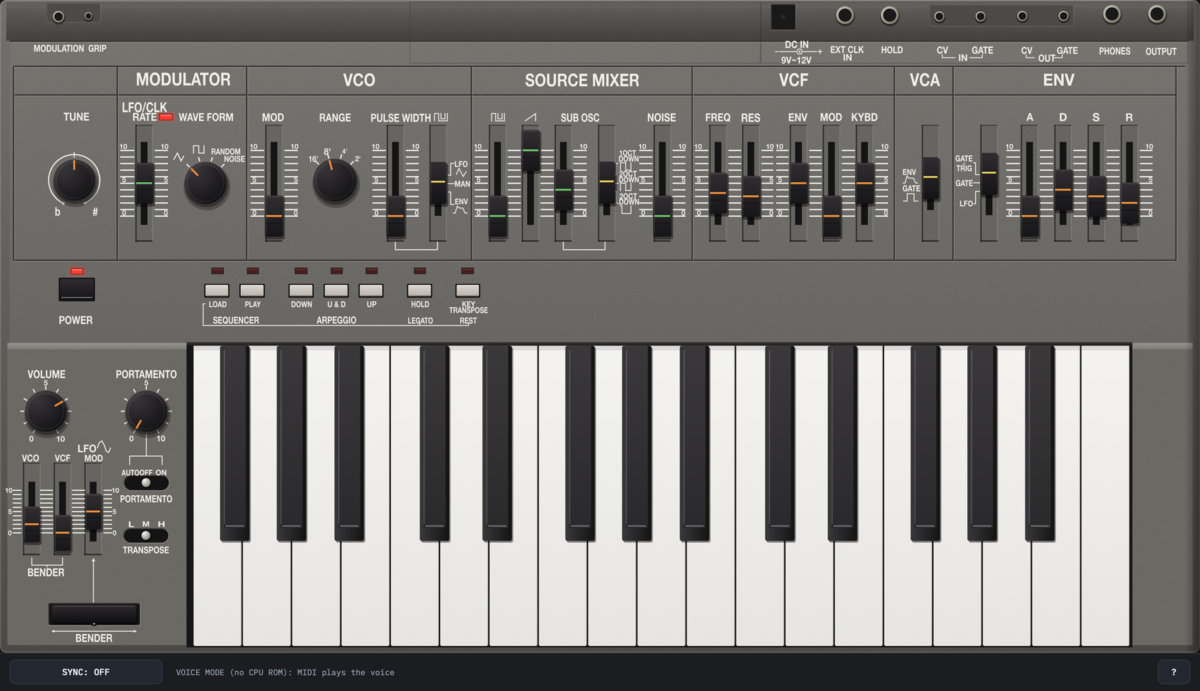
ROM image and voice mode

The sequencer, arpeggio and keyboard program is in the CPU's 2 KB mask ROM, Roland's copyrighted work, so it isn't included. MAME has no SH-101 set; the image ro-mono-101 takes, tmp80c49p-6-7301.ic6, is the dump published with the SH101_Disassembled project on GitHub. With it, ro-mono-101 runs the program on an emulated CPU. Without it, ro-mono-101 runs in voice mode: the same synth board over MIDI, with no sequencer or arpeggio. The ROM and voice mode

Panel artwork

Roland's logo and the SH-101 logo are trademarks, so their two places on the panel are blank. Each place takes an SVG or PNG file of your own, named ro-mono-101-maker and ro-mono-101-model, in the ROM folder: drawn yourself, or generated with an AI tool such as Claude or ChatGPT. Panel artwork