ac-digital-vc
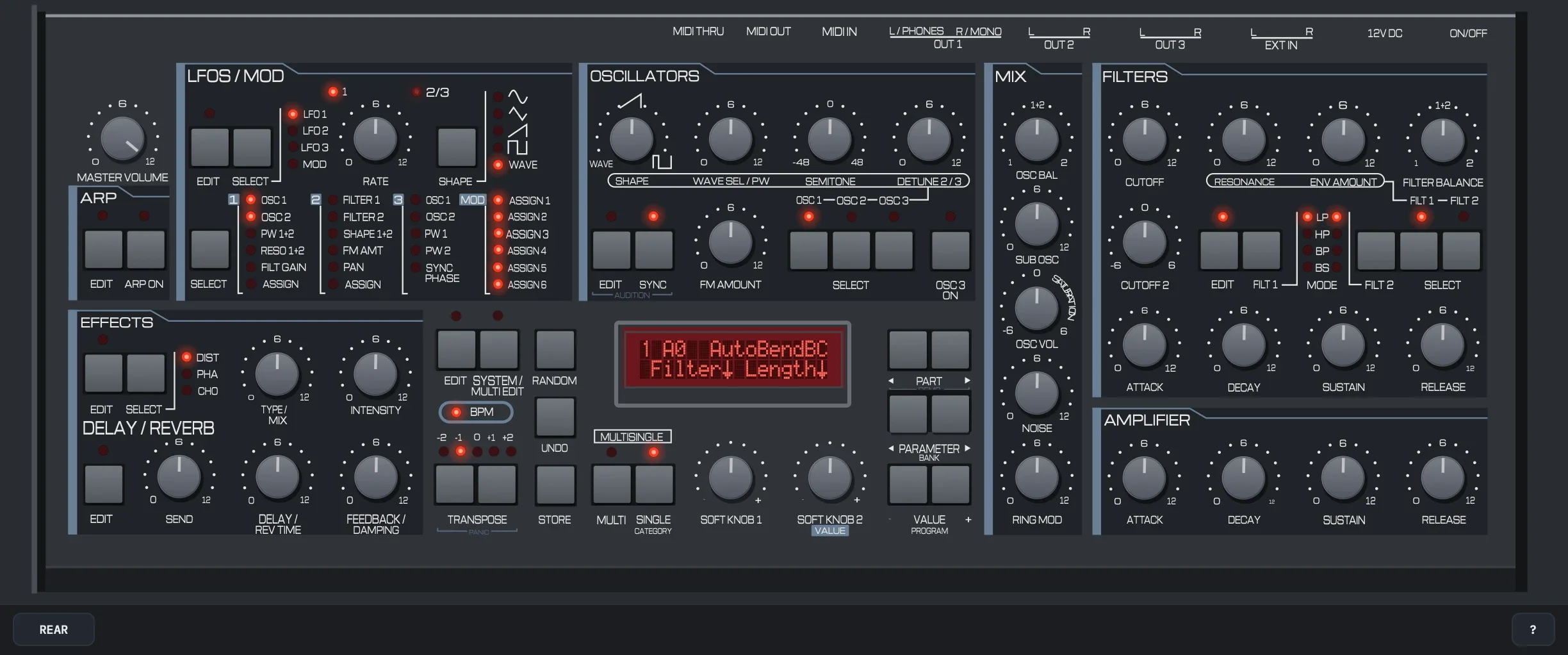
Access Virus C emulation
Expect bugs, and changes before 1.0. The installers aren't signed yet, so macOS and Windows warn before opening them. How to open them
- Emulates
- Access Virus C
- Year
- 2002
- Type
- virtual analog synth
- Status
- working
- Without ROM
- [✗] ROM missing
- ROM image
- virus_c_660x368.bin, not included
- Outputs
- OUT 1, OUT 2, OUT 3, stereo
- Inputs
- EXT IN L and R, as a side-chain
- macOS 11+
- Universal: AU, VST3, standalone
- Windows 10+
- VST3, standalone
Release announcements by email
Nothing else is sent. Mailing list
In numbers
The firmware's paths checked against Gearmulator's Osirus, which runs the same DSP engine with its 80C515 replaced by C++. Method: How it was made.
The clips at the top: factory programs as a new instance holds them, played from MIDI, every knob where the program puts it.
What is still different
- Against real units
- The recordings of Virus Cs that exist are phrases on factory programs: Access's own 2002 web demos and videos. E73 PowerStrnJ's chords match within 3.5–5.3 dB per third octave with their notes guessed from the spectrum, and an A/B by ear against them passed. No recording has isolated notes on known settings.
- After the DACs
- The op-amp stage between the DACs and the jacks isn't modelled, nor the inputs' converter: the photos of the board don't show their parts.
- The DACs' mute
- After 0.17 s of digital silence the CS4390s mute, and the output is exact zeros. Whether the board enables that isn't known.
- The sample rate
- 46,875 Hz, 12 MHz / 256: Gearmulator's figure and what the DACs' clocking gives, not measured on a unit.
- A new instance
- Its RAM banks A and B are copies of flash banks C and D, as a unit fresh from the factory might hold; what Access put there isn't known.
- STORE TO FLASH
- It writes the flash, kept with the session. The DSP program that holds the bank meanwhile is stood in for, from what the firmware asks of it, and erasing is instant where the chip takes about a second.
- LEDs
- 12 of 69 are placed by their wiring order alone: LFO 2's and LFO 3's destinations, and BPM.
- CPU
- The DSP's code is compiled the first time it runs. Code no earlier program used costs up to 8 ms in one audio block: 3 blocks over 2.67 ms across all the factory programs, none the second time.
Not emulated
The power-on keys (State, Reset… in the top bar starts a fresh memory instead), MIDI THRU, and the analog stages above.
How it was made
- 01
The firmware
OS 6.6 runs from reset: the 80C515's program on an emulated 80C515 (MAME's MCS-51 core with the C515's own peripherals from Siemens' manual), which loads the DSP's program over the host port into a DSP56362 on the dsp56300 recompiler, Gearmulator's DSP engine. The board around them was traced in the firmware: the key matrix and LED latches, the battery RAM and flash banks, the port pin that selects the host port and the one that lets the firmware write its own flash. Every key and menu page, and the LEDs, were then checked against the owner's manual.
- 02
Against Osirus
Gearmulator's Osirus runs the same DSP engine but replaces the 80C515 with C++, so it checks the control side. The same MIDI goes into both, and what each sends the DSP is compared word by word: the DSP's program, the upload of every factory program, every kind of channel message, sysex parameter changes, single dumps and multi mode. In multi mode 15 of 16 parts match; on the 16th, Osirus loads the wrong program. The comparison also found a bug here, now fixed: part 1's edit buffer read back through the host port.
- 03
The DACs
Photos of a Virus C's board show three Cirrus Logic CS4390s, one per stereo output. Their response is modelled from the datasheet: the filter fitted to its plots within 0.16 dB, flat to 21.3 kHz with 25 samples of delay, the noise floor 103 dB under full scale, and the mute.
ROM image
The firmware and every factory program are in the unit's flash, Access's copyrighted work, so it isn't included. ac-digital-vc needs the BIOS v6.6 image of MAME's virusc set, virus_c_660x368.bin: without it there is nothing to run. The ROM
Panel artwork
Access's logo and the Virus wordmark are trademarks, so their three places on the panel are blank. Each place takes an SVG or PNG file of your own, named ac-digital-vc-maker and so on, in the ROM folder: drawn yourself, or generated with an AI tool such as Claude or ChatGPT. Panel artwork