pr-dist-r
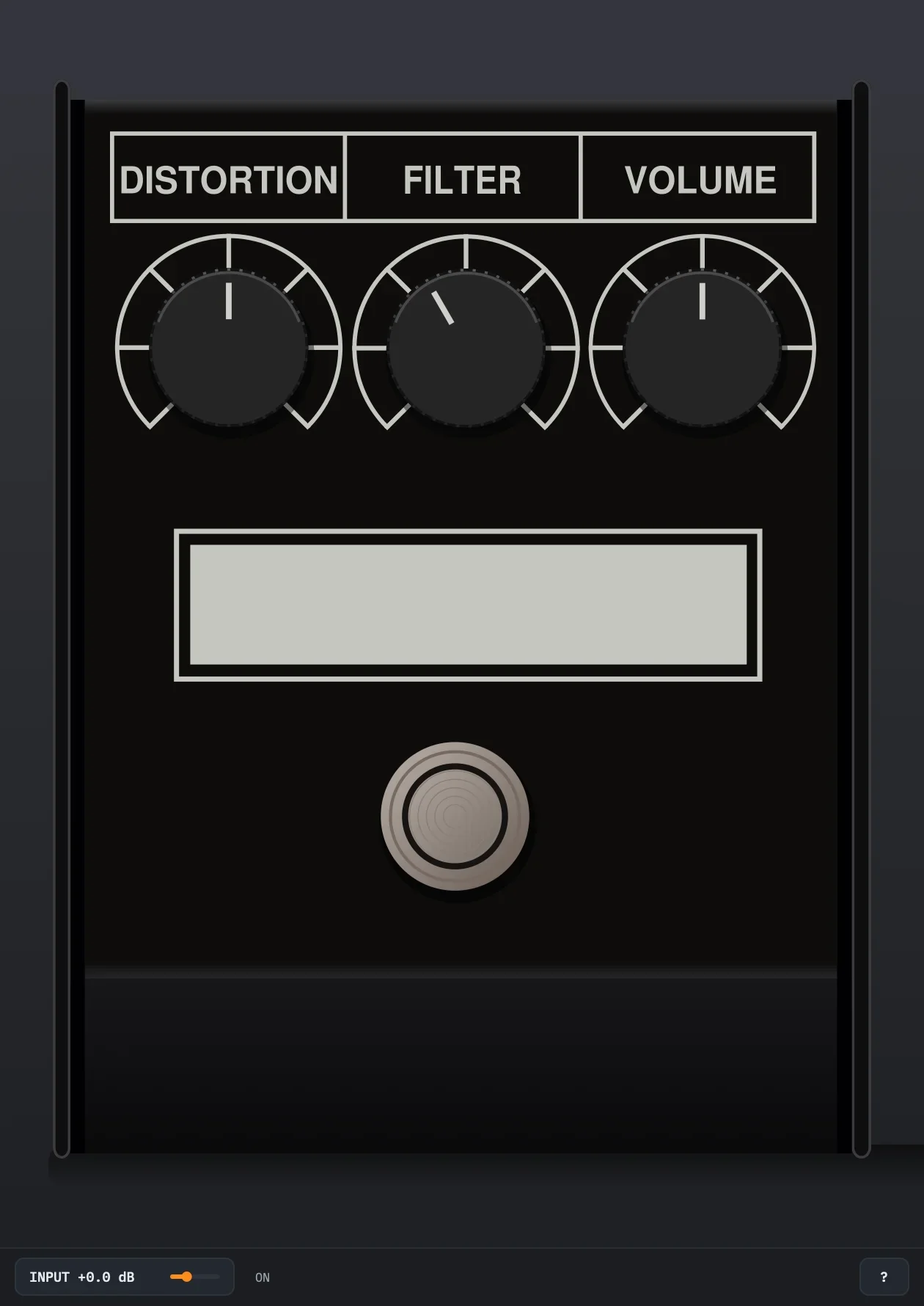
ProCo RAT emulation
Expect bugs, and changes before 1.0. The installers aren't signed yet, so macOS and Windows warn before opening them. How to open them
- Emulates
- ProCo RAT
- Year
- 1984
- Type
- distortion pedal
- Status
- working
- Without ROM
- [✓] no ROM needed
- Unit
- The small box, "White Face", LM308
- Controls
- DISTORTION, FILTER, VOLUME, the footswitch; INPUT in the bar
- Channels
- Mono or stereo
- macOS 11+
- Universal: AU, VST3
- Windows 10+
- VST3
Release announcements by email
Nothing else is sent. Mailing list
In numbers
The circuit checked against ngspice, and the sound against recordings of real RATs: a capture of a 1984 White Face, a 1990 RAT 2's published scope shots, Aalto University's recordings of a RAT, and captures of later RAT 2s. Method: How it was made.
The clips at the top: a guitar DI and a TB-303 line through pr-dist-r at the knob settings given, INPUT at 0 dB.
What is still different
- The pots
- DISTORTION's and VOLUME's laws are the one vintage RAT pot that has been measured, a 1979 big box's: 10.1 % of its track at half turn. FILTER's is fitted to the 1984 capture, 6 %. No 1984 pot has been measured.
- One 1984 reference
- The White Face capture is one setting with its input level unknown. A second recording would tell its FILTER pot from its filter capacitor and its knob reading.
- Later RAT 2s
- Their newer pots keep FILTER darker at the same knob position: against captures of six later RAT 2s and RATs the distance is 8.6 dB. Against a 1990 RAT 2's scope shots the peak ratio is off by 0.8 % and the harmonics by 4.4 dB, on average. Against Aalto's RAT: 7.1 dB.
- The top end
- Against a later RAT 2 it changes with DISTORTION more than the real one's: a few dB dark above 4 kHz at low DISTORTION, a few dB bright at noon.
- The LM308
- Its slew rate and output swing are fitted to LM308 captures whose levels are not known, and ended at the edge of the range bench measurements give.
- The panel
- Measured from sellers' photos of 1984 units: the print to about 0.05 mm, its overall size to 1.2 %.
Not emulated
The footswitch's click, the supply sagging with the op amp's current, and a guitar pickup's loading (the source is 1 kΩ).
How it was made
- 01
The circuit
Transcribed part by part from ProCo's 1986 drawing and published traces of real units, with the original RAT's values: no input pull-down, a 1 MΩ bias resistor, a 1 µF output capacitor with no resistor across it. The whole circuit, from the input network through the LM308 with its 30 pF compensation, the 1N914 clippers, FILTER and the 2N5458 buffer to VOLUME, is one nonlinear system, solved every sample at 8x oversampling with the nodal DK method and Newton's method. ngspice runs the same netlist for the comparison.
- 02
The parts
The LM308's slew rate, gain-bandwidth and output swing, from its 30 pF compensation and bench measurements, are fitted to a 1990 RAT 2's published scope shots and to captures of two LM308-era RATs; the shared trims to captures of RAT 2s. The pots' laws are a measured 1979 RAT pot's, and FILTER's is fitted to the 1984 capture.
- 03
Against real pedals
Neural-network captures of real RATs made by their owners, Aalto University's recordings of a RAT across its knobs, a 2010 RAT 2 from the EGFxSet dataset, and a 1990 RAT 2's scope shots and spectra. Each comparison renders the same signal through the model at the same settings, then compares spectra, error and the clipping's asymmetry.
- 04
The panel
Measured from sellers' photos of 1984 units. The camera's pose was fitted to the print, with its focal length from the photo's EXIF data, so the rectangles come out square and the scales round. The scale comes from the pots' spacing against their bodies' 15/16 in, and from the small box's leaflet; heights from how far the knobs lean in the photo.
Panel artwork
ProCo's logos and the RAT wordmark are trademarks, so their three places on the panel are blank. Each place takes an SVG or PNG file of your own, named pr-dist-r-model and so on, in the ROM folder: drawn yourself, or generated with an AI tool such as Claude or ChatGPT. Panel artwork
pr-dist-r is a circuit with no firmware: it needs no ROM.