ob-poly-xp
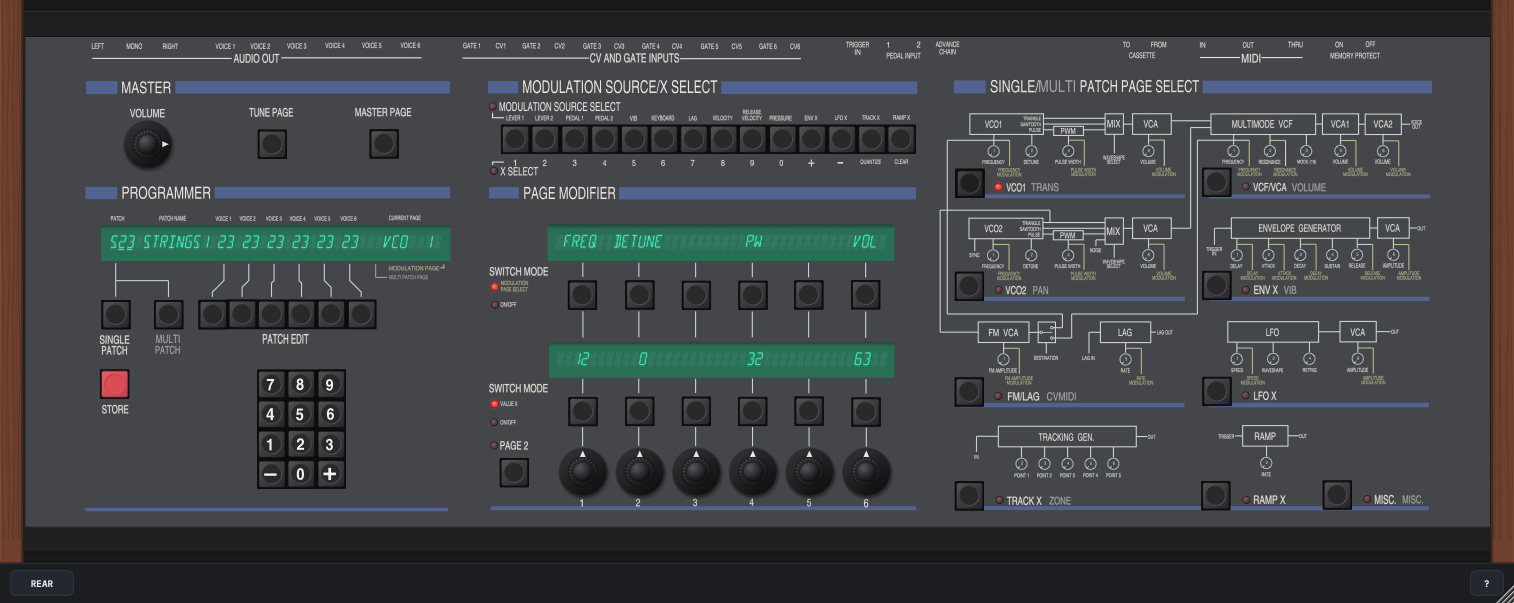
Oberheim Xpander emulation
Expect bugs, and changes before 1.0. The installers aren't signed yet, so macOS and Windows warn before opening them. How to open them
- Emulates
- Oberheim Xpander
- Year
- 1984
- Type
- poly synth module
- Status
- working
- Without ROM
- [✗] ROM missing
- ROM images
- Six EPROMs, main software 1.2 and voice software 1.4, not included
- macOS 11+
- Universal: AU, VST3, standalone
- Windows 10+
- VST3, standalone
Release announcements by email
Nothing else is sent. Mailing list
In numbers
Checked against the service manual's own checks, an ngspice simulation of the transcribed circuit, freesound recordings of real Xpanders' notes and YouTube recordings of Xpanders and of Matrix-12s, which use the same voice boards. Method: How it was made.
The clips at the top: ob-poly-xp alone, with no effects, playing Oberheim's factory patches (FACTORY1.SYX, which ob-poly-xp loads if it's in the ROM folder).
What is still different
- RES 62 to 63
- With the filter cells' tanh, the oscillation at RES 63 sits about 265 cents under the cells' small-signal cutoff. The firmware tunes the filter on that oscillation, so from RES 62 to 63 the pitch drops about 2.6 semitones. Whether the real chip drops that far isn't known.
- Fitted on one unit
- VCF OUT's gain, 0.88 of the data sheet's, from one Matrix-12's phaser modes (a factory-demo patch agrees); the input VCAs' taper above 2.7 V, from two units, extrapolated below.
- Chosen values
- No recording pins the resonance VCA's CV law (linear), the output level (0 dBFS is 10 V at the outputs), or VOLUME's taper.
- The voices are alike
- Their levels differ as on one real unit, but their oscillators and filters have no spread, so one factory tune serves all six.
- Units differ
- The recordings at hand come from units with their own chains: one Matrix-12's video runs 5–7 dB brighter above 4 kHz than ob-poly-xp and two Xpanders, after the voice. And a Matrix-12 opens a filter envelope's short DELAY at once where an Xpander waits for it, as ob-poly-xp does.
Not emulated
The cassette interface; CV 1-6, GATE 1-6, TRIGGER, CHAIN ADVANCE and the pedal jacks, which read as unplugged (the unit's own MIDI CONTROLS page takes PEDAL 1 and 2 from MIDI controllers instead); temperature and drift; voice boards before revision D; factory multi patches (none has been found).
Own an Xpander or a Matrix-12?
Recordings at known settings settle these: one held note at RES 62 and at 63 with the same FREQ; one low note in 4 POLE LOW at a series of RES values, from a VOICE output; a phaser mode at a known FREQ and RES.
How it was made
- 01
The firmware
Both of the Xpander's processor boards run their original programs from reset on emulated 6809s (ported from MAME's core): the main board's (panel, displays, patches, modulation, MIDI) with its FIRQ timer and switch matrix, and the voice board's, which sets the 54 sample-and-holds through one 14-bit DAC, times the voices with its 8253 counter and runs TUNE. Every CV reaches the voices as the firmware writes it, cycle by cycle.
- 02
Schematic and SPICE
Each voice was transcribed from the service manual's schematic and modelled part by part: the two CEM3374 oscillators with their timing networks, the waveshapers and the pulse comparators, the mix buses and the FM paths, the CEM3372 filter with its 15 pole-mixing modes and resonance loop, the VCA, the pan section and the output stage, at four times the host's rate. Every block was compared with ngspice: 88 cases.
- 03
The unit's own checks
The service manual's checks run through the firmware and pass, TUNE ALL included: it measures each voice's oscillators, pulse widths, resonance, filter and VCA, and stores the corrections in battery RAM as on a real unit. A new copy of ob-poly-xp does what a new Xpander did: RESET MEMORY, then TUNE ALL.
- 04
Real units
Then recordings, per note and per patch: pitch against four sets of Xpander notes; the waveforms, the noise and the 15 filter modes against Matrix-12s (Vulture Culture's, gstormelectro's); all 100 factory patches against a factory demo and a dry one (synthlegends'), and a free user bank against a Matrix-12 playing it with every setting known. Where a unit and its recording differed from the others, ob-poly-xp follows what the units agree on (Differences).
ROM images
The firmware is in six 8 KB EPROMs, Oberheim's copyrighted work, so none is included: four main-board ROMs (software 1.2) and two voice-board ROMs (software 1.4), MAME's xpander set, with MAME's names. ob-poly-xp needs all six; without them it makes no sound. Oberheim's factory single patches, FACTORY1.SYX, are optional: with them a new unit starts on patch 00, without them the single patches start blank. The ROMs
Panel artwork
Oberheim's logo and the Xpander logo are trademarks, so their two places on the panel, and on the rear, are blank. Each place takes an SVG or PNG file of your own, named ob-poly-xp-maker and ob-poly-xp-name, in the ROM folder: drawn yourself, or generated with an AI tool such as Claude or ChatGPT. Panel artwork